
Finding ways to keep the whole family occupied without falling back on the same routines requires a bit of method. The activities that work on a daily basis share a common point: they adapt to ages, budget, and available time. This article explores several concrete ideas for family entertainment, drawing on recent trends in leisure activities in France.
The cost of family leisure: a filter to apply before choosing
Before listing ideas, we need to talk about price. According to an Odoxa survey for RTL reported by Sporteco, a significant portion of the French have given up on a sport activity deemed too expensive. Others have turned to a less costly solution.
This observation changes the way we think about family leisure. Rather than aiming for a spectacular outing every weekend, it’s better to alternate between free or low-cost activities and a more ambitious outing from time to time.
The idea catalogs found on https://www.sedivertir.eu/ help to identify activities categorized by type and accessibility, which saves time searching at the last minute.
Have you noticed that the best family evenings are often those that cost nothing? A card game, an impromptu walk, a cooking workshop with leftovers from the fridge. Shared enjoyment does not depend on the budget spent.

Hiking and walking: the family activity on the rise
Walking has become much more than a Sunday stroll. According to a study conducted in 2025 by the Union Sport & Cycle for the French Hiking Federation, walking or hiking is practiced as a leisure activity by a majority of French people. Participation has increased since 2021.
Why this success? Hiking ticks all the boxes for a successful family activity: it’s free, adjustable in duration, accessible from a young age (with a baby carrier), and can be done almost anywhere in France.
Adapting the route to the children’s ages
A four-year-old will not manage a ten-kilometer trail. The goal is not performance but experience. Here are some concrete guidelines to keep the outing enjoyable:
- Choose a short loop trail with a visible point of interest (river, viewpoint, ruins) to maintain the motivation of the younger ones
- Plan frequent breaks with a snack, especially if the walk exceeds an hour
- Combine the walk with a small observation game (counting birds, collecting different leaves) to turn the walk into an exploration
Biking has also increased between 2024 and 2025, making it an interesting alternative for equipped families. Greenways and marked bike paths offer a safe environment, even with young cyclists.
Home activities: going beyond ready-made idea lists
Lists like “50 activities to do at home” are abundant online. The problem is that they present suggestions without explaining how to make them sustainable. Baking on a Saturday is nice. Making it a weekly ritual that involves the whole family is another matter.
Establishing rituals rather than multiplying new activities
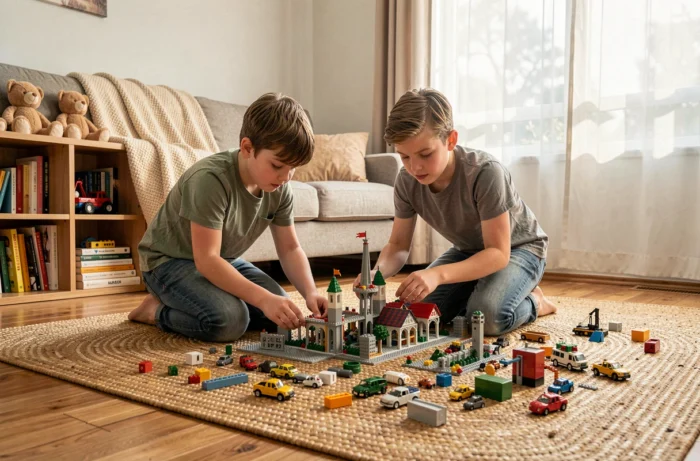
Children love repetition. A fixed weekly appointment creates anticipation and structures free time. For example: a cooking workshop on Wednesday and a board game night on Friday. Two time slots are enough to establish a rhythm.
Board games deserve special mention. Unlike screens, they impose a social framework: waiting for one’s turn, negotiating, losing. For children aged six to ten, it’s a concrete learning ground. For parents, it’s a moment when the phone stays in the pocket.
Limiting screens without demonizing them
Watching a movie as a family is not problematic if it’s a shared choice. What raises questions is passive and solitary use. Replacing an hour of individual screen time with a collective activity has a visible effect on family atmosphere within a few weeks.
Cultural outings with the family: an underestimated lever
The 2025 Cultural Outings Barometer from the Ministry of Culture notes attendance levels similar to those of 2024, but with a slight decline for several cultural venues and events. This decline does not indicate a lack of interest; rather, it reflects budgetary trade-offs.
Free museums on the first Sunday of the month, municipal libraries, and local festivals remain accessible options. Many cities also offer heritage trails suitable for children, with game booklets to support them.
Choosing the right outing based on age
Taking a three-year-old to a contemporary art exhibition is likely to frustrate everyone. In contrast, natural history museums and aquariums capture the attention of young children due to their sensory dimension. For preteens, cultural escape games or theatrical visits work well.
The main criterion is not the prestige of the venue but its ability to actively engage participants. A visit where the child manipulates, explores, or solves puzzles is worth ten passive visits.
Building a balance between indoors, outdoors, and outings
The real challenge is not finding activity ideas. It’s organizing them over time without it becoming an additional mental burden. Alternating three formats each week is sufficient: one activity at home, one free local outing, and occasionally a planned paid outing.
Families that maintain this rhythm over several months often find that children request screens less and propose activities themselves. A regular family program, even modest, eventually becomes self-sustaining.