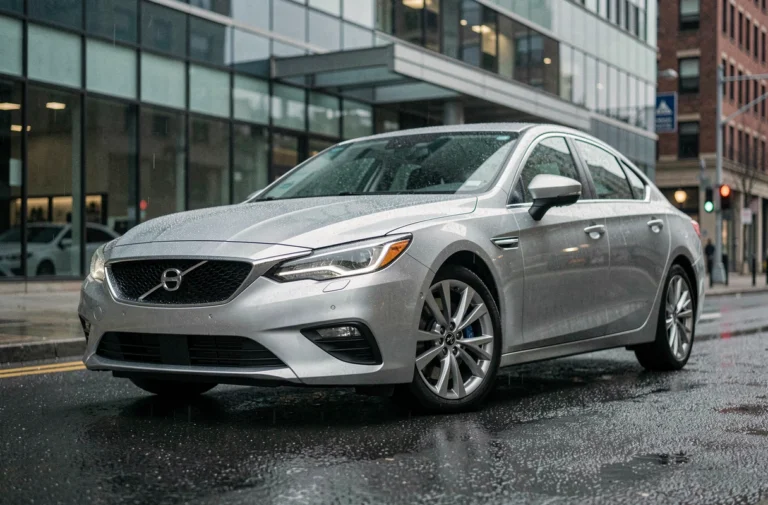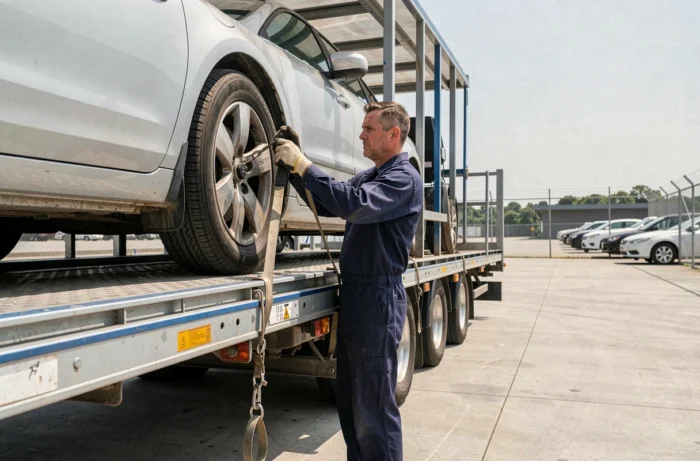
Moving a vehicle from one location to another without driving it yourself involves three distinct methods: professional vehicle delivery by a driver, truck transport (on a flatbed or car carrier) and, for international journeys, sea freight. Each option addresses specific technical requirements related to the vehicle’s condition, the distance and the level of protection required.
Goods-in-custody insurance and transport licence: two checks to make before requesting a quote
Before comparing prices, one point deserves particular attention: the provider’s legal and insurance status. A carrier’s standard professional liability insurance does not automatically cover damage to the vehicle during transit. You should require specific “goods-in-custody” insurance, separate from both the owner’s car insurance and the carrier’s professional liability insurance.
For road freight transport on behalf of third parties, the Ministry of Transport maintains a register of licensed companies. Checking the provider’s SIRET number, licence and insurance certificate before handing over the keys is a basic precaution that many individuals overlook. This check takes just a few minutes and can prevent lengthy disputes in the event of a claim.
For vehicle delivery by a driver, the vehicle’s motor insurance must also cover the designated driver. If the green card lists only a regular driver and does not include a clause allowing another person to drive, the vehicle may be driven without valid insurance cover for the entire journey. Checking with your insurer takes less time than filing a claim that is not covered.
Comparing quotes for transport on Car Affaires makes it easy to review several providers and filter out those that do not clearly state their cover.
Professional vehicle delivery: how the “driven” option works and its limitations
Professional vehicle delivery involves handing the keys to a driver who drives the car to its destination by road. The vehicle must be roadworthy, with a valid roadworthiness test and correct fluid levels.
This option offers a logistical advantage: the vehicle is collected from your home, so there is no need to take it to a collection point. The journey follows the regular road network, making it suitable for medium-distance trips within mainland France.
The main limitation is mechanical. Every kilometre driven is added to the odometer, directly affecting the vehicle’s residual value. For a recent city car, the impact is modest. For a classic car or a low-mileage vehicle whose value depends on its odometer reading, driving it to its destination reduces the value of the vehicle being transported.
The other limitation concerns vehicles that are not roadworthy, such as those with a mechanical fault, a flat battery or recent accident damage. In these cases, delivery by a driver is simply not an option, so the vehicle must be transported by truck.
Flatbed or car carrier transport: how to choose
Truck transport falls into two main categories, each suited to different needs.
Open car carrier and shared transport
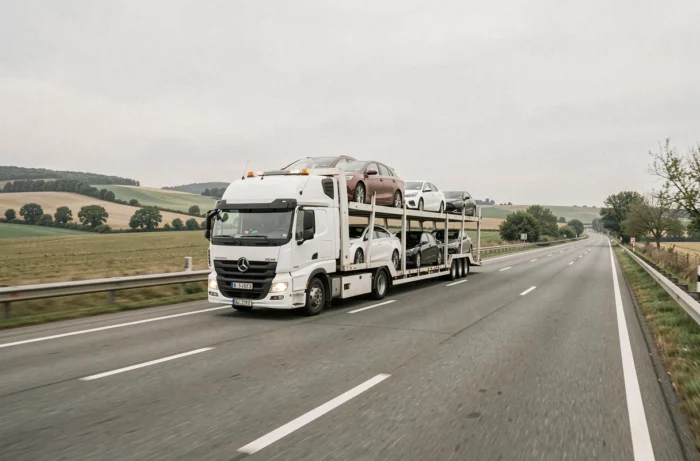
A car carrier truck (often called a “car transporter”) carries several vehicles on the same journey. This shared-load system significantly reduces the cost per vehicle compared with dedicated transport. It is suitable for standard-sized vehicles, whether roadworthy or not, and works well for long-distance routes in France.
The trade-off is timing. The carrier optimises its load and may wait until the truck is full before setting off. Delivery windows are therefore less precise than with express transport.
Enclosed truck or dedicated flatbed
For luxury, classic or competition vehicles, an enclosed truck provides protection from the weather, road debris and prying eyes. A dedicated flatbed, meanwhile, carries just one vehicle and comes with a guaranteed time slot.
Both options are considerably more expensive. They are worth considering when the vehicle’s value or condition (fragile bodywork, fresh paintwork) calls for a higher level of protection. A damaged or written-off vehicle also requires a flatbed, as it cannot be driven or loaded onto a standard car carrier without winching equipment.
- Open car carrier: suitable for standard-sized vehicles, best cost-to-distance ratio, flexible delivery times
- Dedicated flatbed: fast collection, one vehicle only, suitable for non-running and accident-damaged cars
- Enclosed truck: maximum protection from the weather and impacts, reserved for high-value vehicles

Oversized vehicles: a regulatory requirement that is often overlooked
An American SUV, a high-roof campervan or a converted van may exceed the regulatory limits for dimensions or weight for standard transport. In that case, the journey falls under the abnormal-load transport regulations, which require additional procedures.
Depending on the extent to which the limits are exceeded, a declaration or prefectural permit may be required. Traffic rules may restrict travel to certain days and times, increasing delivery times and affecting the price.
Before requesting a quote, accurately measure the vehicle’s height, width and total weight, including any accessories such as a roof rack, bike rack or tow bar. This helps avoid surprises on loading day.
Distance, vehicle condition and value: the three deciding factors
The choice between delivery by a driver and truck transport should not be made at random. Three factors are enough to guide your decision.
- Distance: for a short journey, delivery by a driver is straightforward and economical. For journeys of several hundred kilometres or more, shared transport on a car carrier becomes competitive
- Vehicle condition: a vehicle that is not roadworthy, has broken down or has been in an accident rules out delivery by a driver and requires a flatbed or a car carrier equipped with a winch
- Value: a vehicle whose value depends on its mileage or cosmetic condition may warrant an enclosed truck, even if the extra cost is significant
Choose the transport method based on the vehicle, not just the budget. Choosing delivery by a driver for a classic car to save money means reducing the value of the very asset you are trying to protect. Conversely, paying for an enclosed truck to transport a used city car with high mileage has no technical justification.
Before approving a quote, one final precaution is to request a joint condition report at both collection and delivery. This dated photographic record, signed by both parties, is the only admissible evidence in the event of a dispute over damage sustained during transport.