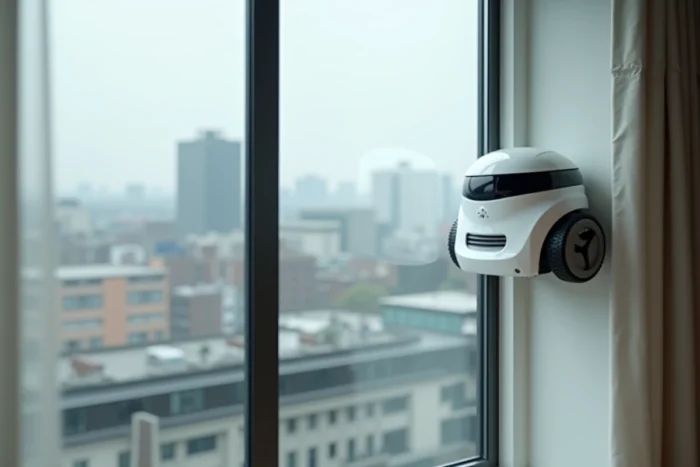
Window cleaning robots are increasingly occupying space in the home appliance aisles, driven by the promise of autonomous and effortless cleaning. In the face of the growing number of models and brands, tests conducted by UFC Que Choisir provide independent insights into their actual performance. The results of these evaluations reveal notable discrepancies between the advertised features and the behavior observed in the laboratory.
UFC Que Choisir Evaluation Method: What Distinguishes an Independent Test from a Commercial Comparison
Most comparisons visible online rely on affiliate programs. The products presented generate a commission for the site recommending them, which mechanically skews the selection towards the most profitable models. Commercial mentions, often relegated to the bottom of the page, go unnoticed by the majority of readers.
The approach of UFC Que Choisir is based on a different protocol. Tests are conducted by engineers in independent laboratories, with criteria focused on the ability to perform the main function, ergonomics, and safety. This standardized method allows for comparison of robots under identical conditions, which isolated user feedback or sponsored videos do not guarantee.
To consult the details of these evaluations, the UFC Que Choisir reviews on window cleaning robots summarize the results of these test benches and the criteria retained by the association.

Edge and Corner Cleaning: The Recurring Weak Point of Window Cleaning Robots
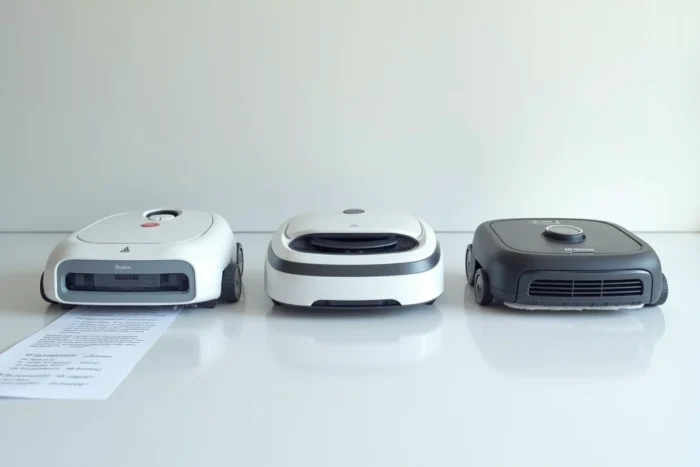
The robot’s behavior near the window frame is a determining criterion. The shape of the device, round or square, largely determines its ability to reach corners. Round models systematically leave an uncleaned strip in the corners, sometimes several centimeters wide.
Square-shaped robots, like some Ecovacs Winbot models, reduce this dead zone. However, even with this more suitable geometry, user feedback varies on the cleanliness achieved along the window seal or on textured PVC frames.
Glass Surface and Navigation
The size of the glass also influences the result. On a large bay window, the robot has enough space to deploy its navigation path (in zigzag or spiral). On a small tile, the robot struggles to reposition itself and makes multiple passes over the same areas, without covering the entire surface.
The suction navigation system, used by most models, keeps the device pressed against the glass. This suction must remain constant to prevent any falls, which consumes a significant portion of the battery power, to the detriment of the energy available for actual cleaning.
Safety and Backup Battery: Features to Check Before Purchase
Using a window cleaning robot at height raises safety questions that commercial comparisons often address superficially. Two mechanisms coexist on the market:
- The safety cable, fixed by suction cup or carabiner to the window frame, which holds the device in case of loss of adhesion
- The integrated backup battery, which maintains suction for a few minutes in case of power failure on wired models
- The sound alert system, which warns the user when the suction power drops below a critical threshold
The absence of a backup battery on a wired model represents a real risk for use on upper floors. This criterion, systematically evaluated in UFC Que Choisir tests, does not always appear in commercial descriptions.
Wired or Wireless Models: A Choice That Changes Usage
Wired robots draw their power from a wall outlet, ensuring constant suction power. Wireless models operate on battery, with autonomy varying according to capacity and the surface to be covered. A wireless model offers more freedom of movement but requires monitoring the charge level.
On the exterior windows of an apartment, the length of the power cable or the battery life become concrete constraints that technical specifications rarely express in real-world usage conditions.
Spraying and Water Reservoir: The Real Effectiveness of Wet Cleaning
Several robots incorporate a spraying system with an onboard reservoir. The principle: the robot moistens the glass before passing its cloth, mimicking the gesture of manual cleaning. In practice, the capacity of the reservoir limits the number of windows that can be treated in a single session.
An overly small reservoir forces a water refill every two or three windows, which partially negates the expected time savings. Models without spraying require pre-moisturizing the glass or the cloth, adding a manual step.
The quality of the supplied microfiber cloth also plays a crucial role. Some cloths leave streaks as they dry, especially on windows exposed to the sun. UFC Que Choisir tests evaluate the final result on dry glass, revealing performance discrepancies that are not easily visible in video demonstrations conducted under controlled conditions.
Window Cleaning Robots in Real Conditions: What Tests Do Not Always Measure
Laboratory protocols reproduce standardized dirt on flat surfaces. However, in a home, windows present particularities that the robot must manage:
- Stickers or silicone sealant residues, which can block the device’s progress
- Double-glazed curved windows or tilt-and-turn windows, whose geometry complicates suction maintenance
- Limescale marks due to outdoor watering, which are significantly more resistant than typical household dirt
The available data do not allow for a conclusion that these devices completely replace manual cleaning on heavily soiled windows. The window cleaning robot performs better with regular maintenance than with catch-up cleaning.
The operating noise, related to the suction motor, is also a parameter to consider. Some models generate a noise level comparable to that of a traditional vacuum cleaner, making their use uncomfortable during a long session.
The market for window cleaning robots continues to evolve, with improvements in navigation and battery management. Independent tests remain the best filter to distinguish devices that live up to their promises from those that are more of a gadget. A clean window in the corners, a reliable safety system, and a reservoir suitable for the size of the home concretely guide the choice towards the most advanced models.