
The code 1525F3 on a Renault vehicle indicates an inconsistency detected by the engine control unit between several sensor signals, mainly related to engine torque or communication on the CAN network. After an oil change or battery replacement, this code frequently appears without any actual part being faulty. Here, we detail the technical mechanisms at play and the diagnostic errors to avoid.
Charging Circuit Verification Protocol After Battery Replacement
The 1525F3 is not a mechanical fault code in the strict sense. On Renaults with a multiplexed CAN network, a momentary voltage drop is enough to desynchronize several control units. The engine module then interprets a coherence fault on the CAN frames as a real anomaly in torque or injection.
We observe that the majority of post-battery appearances stem from three electrical causes, not mechanical:
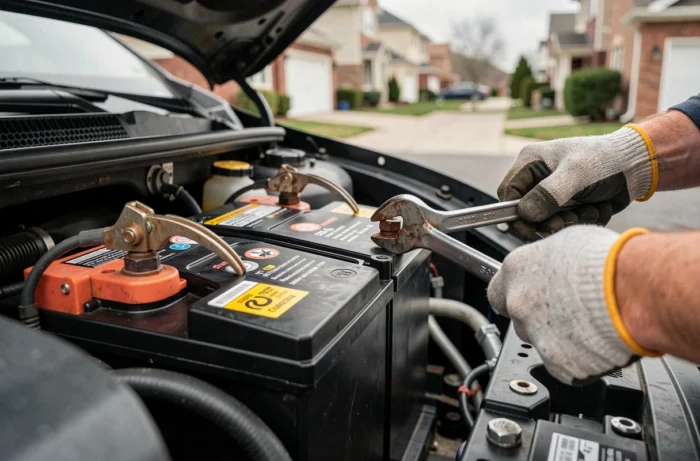
- A battery terminal that is not tightened sufficiently, generating variable contact resistance that causes the voltage to drop below the stable operating threshold of the control units.
- A corroded or poorly reconnected engine ground, disrupting the reference potential of the CAN network and skewing the measurements of analog sensors (pedal, throttle).
- An alternator delivering unstable voltage, which maintains the fault even after clearing it with a diagnostic tool, because the source of the problem persists while driving.
Before clearing the code, the battery voltage should be measured with the engine running. A stable value between 13.8 V and 14.4 V confirms a healthy charging circuit. Below this, the fault will systematically return.
To understand the Renault code 1525f3 in this context, one must think upstream of the code itself and treat the charging circuit as the primary suspect.
Code 1525F3 After Oil Change: Distinguishing an Oil Fault from an Electronic Fault
After an oil change, the reflex is to suspect the oil. In most cases we encounter, the code 1525F3 has no relation to the grade or level of oil. The engine control unit does not directly monitor viscosity. However, an intervention under the hood can accidentally disconnect a connector or pinch a harness.
The oil pressure sensor, located near the filter on many Renault blocks, has a fragile connector. A slight shock when unscrewing the filter is enough to create an intermittent false contact. The control unit then receives an incoherent frame and raises the 1525F3 as a precaution.
Targeted Post-Oil Change Verification
We recommend visually checking each connector in the intervention area. A connector with a broken locking clip does not necessarily generate an immediate fault, but it will do so at the first pothole.
On diesel engines with a particulate filter, an oil change with an incorrect oil grade can trigger other codes (related to regeneration), which in turn disrupt the overall coherence of the network and cause the 1525F3 to appear as a secondary code. The isolated 1525F3 does not identify the faulty part: all present codes must be read to trace back to the root cause.
Relearning the Renault Throttle Body: Procedure and Limitations
The electronic throttle body memorizes a calibrated resting position. Any prolonged power cut (battery change, disconnection for intervention) can erase this calibration. The control unit then detects a discrepancy between the torque request and the actual throttle position, triggering the 1525F3 and activating limp mode with reduced power.
Automatic relearning works on some models after several contact/start/stabilized idle cycles. On others, a specific throttle adaptation command via a compatible Renault diagnostic tool is necessary. A simple battery disconnection does not always suffice to restart the procedure.
Why Generic Tutorials Fail
Sequences like “turn on the ignition, wait 10 seconds, turn off, restart” found online do not correspond to all Renault control units. Relearning parameters vary according to the model and software version of the control unit. On a Scénic III, the procedure differs from that of a Clio IV, even with the same type of engine.
We recommend referring to the technical documentation of the specific model or using a diagnostic tool capable of sending the reset command for the injection body to the engine control unit.

Residual Fault or Active Fault: The Distinction That Avoids Unnecessary Replacements
A critical point we regularly observe: the 1525F3 remains stored as a residual fault even though the initial problem has been corrected. After tightening a terminal or successfully relearning the throttle, the code may persist in the control unit’s memory without being active.
Clearing the code and then driving on a validation route (about twenty minutes under varied conditions, city and highway) allows verification of whether it returns. If it does not reappear, the fault was residual. If it returns, real-time data analysis during driving is necessary, not just reading fixed codes.
Relevant real-time data includes battery voltage, the requested throttle position compared to the actual position, and the accelerator pedal signal. A discrepancy between the request and measurement on any of these parameters points to the faulty component.
Replacing a pedal sensor or throttle body solely based on the 1525F3 code, without having checked these data while driving, amounts to treating a symptom without diagnosis. The cost of a diagnostic session with real-time data reading remains much lower than that of a part replaced in error.