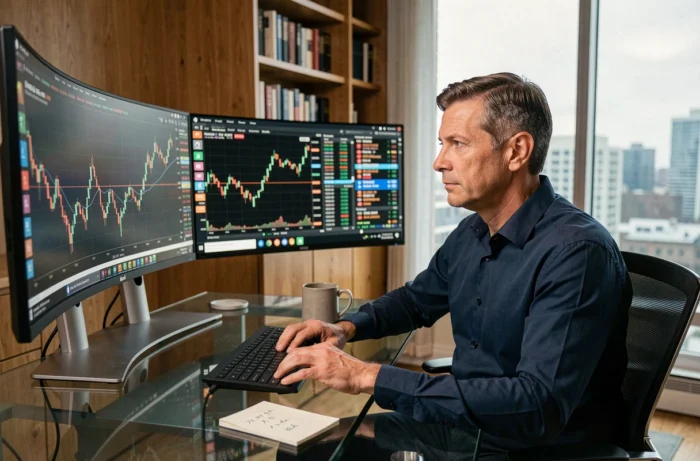
Following the stock market in real-time means accessing a continuous stream of quotes, indices, and economic news updated second by second. This capability relies on precise technical infrastructures (data dissemination protocols, feed aggregators) and on tool choices that directly influence the quality of the information received. Understanding these mechanisms allows one to filter out the noise and retain only the useful signals.
Market Data Dissemination Protocols: What Determines Display Speed
When an order is executed on Euronext Paris, the updated price travels through a market data dissemination protocol before reaching your screen. Latency depends on the number of intermediaries between the stock exchange and your terminal. Online brokers receive a so-called “level 1” feed (best bid and ask prices) or “level 2” (order book depth), and then redistribute it to their clients.
A level 1 feed is sufficient to follow the major trends of the CAC 40. Level 2, on the other hand, displays the volumes waiting at each price level, which is of particular interest to active intraday traders. This distinction matters: an individual who wants to check the stock market on TecFinance to monitor their positions does not have the same needs as an algorithmic trader.
Some platforms impose a fifteen-minute delay on free quotes. This delay, mandated by stock exchanges that monetize their feeds, makes real-time tracking impossible without a paid subscription or going through a broker that includes real-time feed in its offer.

Filtering Stock Market News: AFP Feeds, Alerts, and Aggregators
Agency dispatches (AFP, Reuters) are the primary source of financial news. They simultaneously feed specialized sites, brokerage applications, and generalist portals. What you read on an aggregator is often the same dispatch, reformulated or truncated.
An aggregator does not create information; it redistributes it. The added value lies in the sorting. Three criteria help distinguish an effective tracking tool from a simple mirror of dispatches:
- The ability to filter by sector, index, or specific stock, to receive only news related to your portfolio.
- A clear separation between factual dispatches and opinion content (analyses, analyst recommendations), which do not fall under the same level of reliability.
- The frequency of updates: a continuous feed with precise timestamps is more useful than a page reloaded every five minutes.
Mobile applications add a layer of push notifications. These alerts, set on a variation threshold or the publication of quarterly results, allow for reactions without being glued to the screen. However, their effectiveness depends on the granularity of the settings.
Trading Alerts and Behavioral Biases: An Underestimated Risk
Receiving a notification for every market movement may seem reassuring. The reality is more nuanced. An analysis by the FCA (UK Financial Conduct Authority), published in 2025, showed that frequent alerts can encourage excessive trading activity, regardless of the technical quality of the application.
The issue does not lie in the speed of the price feed. It lies in the frequency and content of the notifications. An alert framed as an opportunity (“Stock X jumps by 5%”) prompts more action than a neutral alert (“5% variation on stock X”).
Gamification and Regulatory Oversight
IOSCO identified in May 2025 badges, rewards, and celebration messages integrated into trading platforms as mechanisms likely to alter risk perception. ESMA then listed digital platforms among its supervisory priorities, particularly regarding leverage effects and the quality of regulatory information.
In practical terms, if your application congratulates you after a purchase or displays rankings among users, it employs gamification tactics that do not serve your interest as an investor. Favoring a sober tool focused on raw data reduces this bias.

Social Media and Financial Promotion: The French Legal Framework
Following stock market trends via social media has become common. Specialized accounts publish real-time analyses, screenshots of order books, and buy recommendations. This practice comes with specific legal and informational risks.
The law n° 2023-451 of June 9, 2023 strictly regulates the commercial promotion of risky financial products by influencers in France. A content creator recommending a derivative product or CFD without adhering to information obligations faces sanctions. The DGCCRF warned on January 27, 2025, about online trading courses that sometimes lead beginners to unregulated Forex or binary options offers.
For a retail investor, the rule is simple: financial information without an identifiable source is not actionable information. A post on social media does not replace a timestamped agency dispatch or an official statement filed with the AMF.
Real-Time Tracking Tools: Concrete Selection Criteria
The choice of a market tracking tool relies more on technical parameters than on the graphical interface. Here are the points to check before committing:
- Access to real-time feed without delay, included in the offer or charged extra (cost varies depending on the covered stock exchange).
- Fine-tuning of alerts: percentage variation threshold, alert on results publication, notification on moving average breaches.
- Clear separation between market data (prices, volumes, indices) and editorial content (recommendations, third-party technical analyses).
- Multi-platform availability (web, mobile app, API for advanced users) with synchronization of watchlists.
A tool that mixes advertising feeds and information feeds in the same interface degrades readability. The most reliable platforms display market data in a space separate from sponsored content.
Real-time stock tracking is not just about watching curves scroll by. The quality of the feed, the regulatory framework of the consulted sources, and the sobriety of the chosen tool determine the relevance of the decisions made. A rigorous setting of alerts, combined with a systematic verification of the source of information, remains the most effective filter against market noise.