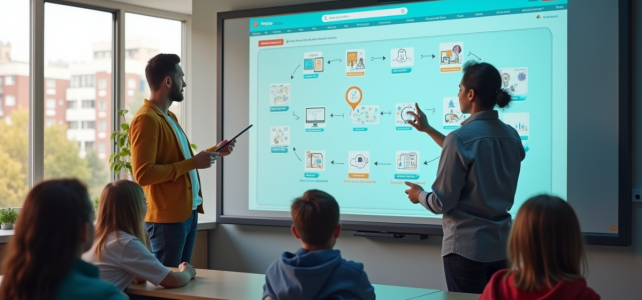
Education is experiencing a silent revolution thanks to a new generation of innovative applications. From interactive platforms to adaptive learning tools, these technologies are redefining how students absorb knowledge. Traditional classrooms are transforming, integrating digital solutions to offer a more personalized and engaging experience.
Applications like Duolingo, Khan Academy, and Google Classroom allow subjects to be approached from a new angle, promoting autonomy and interactivity. They provide resources accessible at any time, making learning continuous and flexible. This transformation opens up unprecedented opportunities for teachers and students, optimizing educational processes for a more promising future.
AI Applications that Personalize Learning
Technological innovation driven by artificial intelligence (AI) is reshaping education. AI applications, such as Woach, transform the learning experience by making it more personalized, adaptive, and engaging. Woach, developed by Kwark Education, stands out for its ability to adapt to the specific needs of each student, adjusting educational content based on their progress and gaps.
The benefits of these applications are numerous:
- Personalization: AI algorithms analyze student performance and adapt the educational path in real-time.
- Engagement: Interactive interfaces and instant feedback motivate students and maintain their interest.
- Accessibility: These tools are available on various platforms, allowing access to education anywhere and anytime.
Innovative Features
AI applications offer various features that enrich learning:
| Feature | Description |
|---|---|
| Predictive Analysis | Anticipates student difficulties and proposes solutions before problems arise. |
| Instant Feedback | Provides immediate answers and corrections to accelerate understanding. |
| Voice Support | Uses voice recognition to help students improve their pronunciation and listening comprehension. |
Thus, Woach positions itself as an essential solution for those looking to optimize their educational journey through advanced technologies. In the face of these innovations, education enters a new era where each student can benefit from teaching perfectly tailored to their needs and pace.
Immersive Technologies for Interactive Teaching
Immersive technologies are revolutionizing education by offering interactive and engaging experiences. Virtual reality (VR) and augmented reality (AR) are at the forefront of this transformation. These technologies allow students to dive into rich and varied educational environments, making learning more concrete and memorable.
Virtual reality creates immersive simulations where students can explore virtual 3D worlds. For example, in a biology class, they can navigate through the human circulatory system, closely observing how organs function. This fosters a deep understanding of complex concepts.
Augmented reality, on the other hand, overlays virtual elements onto the real world through devices like smartphones or tablets. In history, for example, students can visualize reconstructions of historical monuments directly on their desk, facilitating immersion in the past.
The advantages of these technologies are numerous:
- Interactivity: Students actively participate in learning scenarios, increasing their engagement and motivation.
- Accessibility: Immersive educational resources are accessible remotely, allowing for flexible and personalized learning.
- Experiential Learning: Simulations allow students to practice and experiment in safe and controlled environments.
These innovations, by combining immersion and interaction, open new perspectives for education. Students are no longer mere recipients of information but become active participants in their own learning, navigating digital environments that enrich their understanding and stimulate their curiosity.