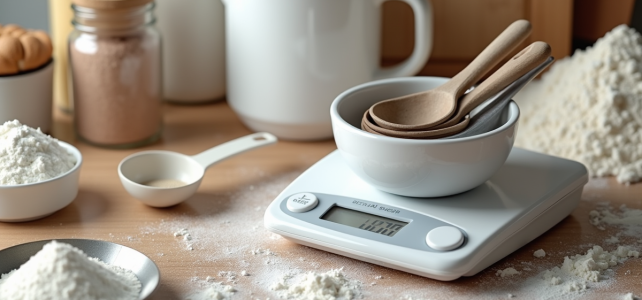
In cooking, successfully executing a recipe often relies on the precision of measurements. A pinch of salt too much or a tablespoon of flour too little can turn a flavorful dish into a culinary disappointment. Chefs and amateurs alike know this well: each ingredient must be measured carefully to ensure success.
Mastering conversions between grams, milliliters, cups, or ounces becomes essential, especially when juggling recipes from around the world. Understanding and correctly using these different units not only allows for faithful reproduction of a dish but also enables experimentation with new flavors with confidence.
Measurement Units: Understanding and Converting Volumes and Weights
Cooking requires a fine understanding of measurement units. The main units used are grams, kilograms, milliliters, and centiliters. One centiliter is equivalent to 0.01 liters, while a deciliter represents 10 centiliters. These conversions are crucial for adapting recipes to different contexts.
Volumes and Weights: Essential Equivalences
- 1 deciliter of pure water = 100 grams
- 1 deciliter of flour = 50 grams
- 1 deciliter of butter = 90 grams
- 1 deciliter of granulated sugar = 85 grams
Mastering these equivalences helps avoid common mistakes. For example, converting 30 centiliters to grams requires knowing the density of the ingredient. For water, 30 centiliters equals 300 grams. This type of information is available in specialized resources like the conversion table for chefs – Paris Avenue.
Tools and Techniques for Accurate Measurements
Use digital kitchen scales for optimal precision. Measuring cups and measuring spoons are also essential for measuring volumes and small quantities. Having a conversion chart on hand makes it easier to adapt when preparing international recipes.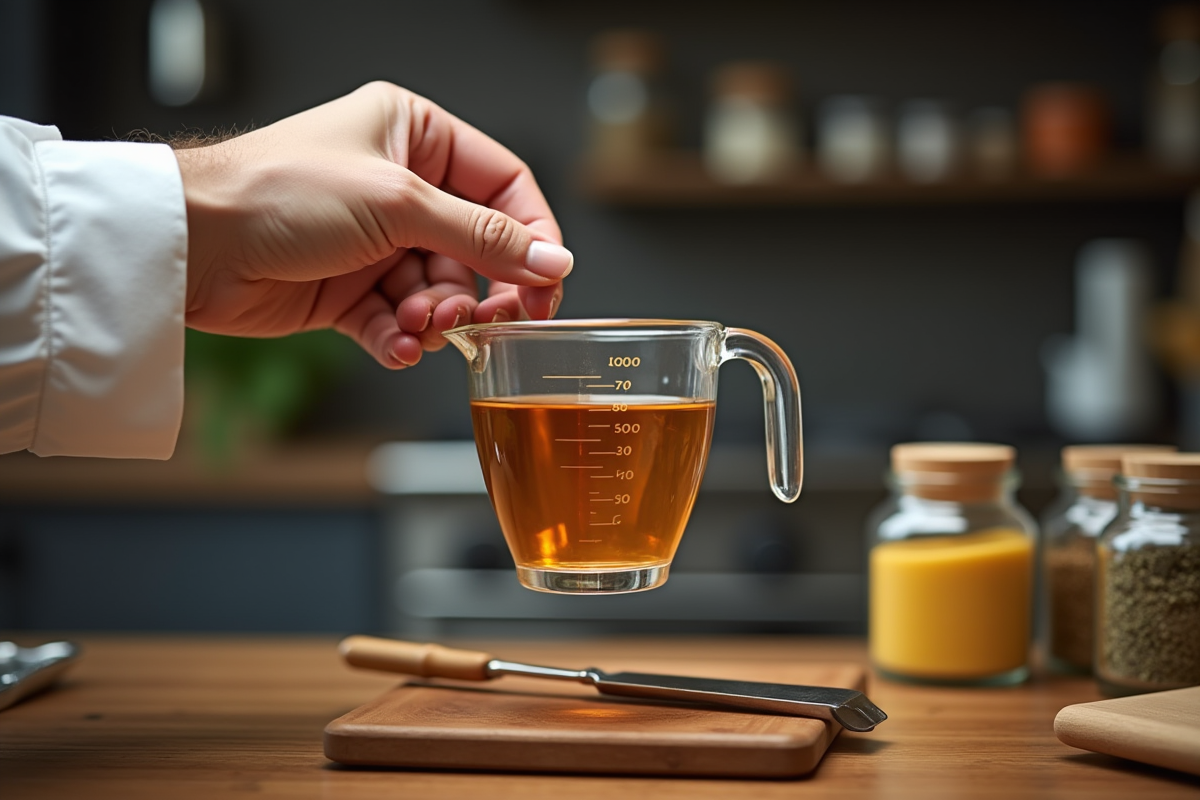
Techniques and Tools for Accurate Conversions in Cooking
The tools available today ensure unprecedented precision in conversions. The digital kitchen scale is a must-have for accurately measuring ingredients, whether in grams or kilograms. Use it to weigh ingredients like flour, granulated sugar, or butter.
Measuring cups and measuring spoons are essential for quantifying liquid volumes and small amounts. A measuring cup graduated in milliliters and centiliters allows for easy conversion between these units. Similarly, measuring spoons, whether tablespoon or teaspoon, provide precision for small quantities of ingredients like spices or leavening agents.
To avoid common errors, use a conversion chart. This makes it easier to convert units of volume and weight, especially when working with international recipes. Here are some essential equivalences:
- 1 centiliter = 0.01 liter
- 1 deciliter = 10 centiliters
- 1 gram = 1/1000 kilogram
- 1 milliliter = 0.1 centiliter
An online converter can also be helpful to avoid conversion mistakes. These tools ensure consistency in culinary results, thus maintaining the quality of taste and texture in your dishes.
By using these techniques and tools, you will master conversions and ensure a consistent and successful culinary experience.